SPEED AND QUALITY THROUGH VISIBILITY AND TRACEABILITY FOR EVERYTHING.

MAIA is a software tool designed to cooperate with the tools you already use.

Visibility

Visibility in a software development pipeline is essential because it transforms complex, raw process data into clear, actionable insights for everyone involved.
Enhancing Understanding and Decision-Making

  • Simplifies Complexity: Visual tools such as pipeline diagrams, dashboards, and heatmaps turn the many moving parts of a CI/CD process into a single, easy-to-understand overview.
  • Enables Rapid Problem Detection: Visualizing each stage lets teams quickly spot bottlenecks, failures, and inefficiencies—enabling fast corrective action before small issues escalate.
  • Supports Informed Decisions: By presenting real-time data visually, teams and stakeholders can make better decisions about resource allocation, process improvements, and deployment timing.

Improving Collaboration and Transparency

  • Breaks Down Silos: Visualization creates a shared view for technical and non-technical team members. This common language bridges gaps, improves communication, and aligns everyone’s understanding of current status and responsibilities.
  • Enables Feedback Loops: Clear visualizations help teams track ongoing performance and see the effects of recent changes, fostering a culture of continuous improvement.

Facilitating Efficiency and Continuous Delivery

  • Accelerates Delivery: Teams using pipeline visualization can reduce development time by up to 50% by immediately identifying redundant steps and streamlining handoffs
  • Optimizes Resources: Insights from visualizations help ensure infrastructure and personnel are used efficiently, minimizing waste and preventing costly pipeline slowdowns
  • Strengthens Reliability: A transparent pipeline supports more consistent releases, faster time-to-market, and improved software quality.

Visualization tools are therefore indispensable for modern DevOps, providing clarity, speeding response, and empowering teams to deliver better software, faster.

People involved in software development need to understand the overall status of the development pipelines to make informed decisions. Smart visualization is critical to achieving speed, quality, and security.

MAIA Software connects and communicates with your tools to accomplish an end-to-end view with all the details at your fingertips.

Traceability

Cross-tool traceability in the development pipeline is crucial for delivering reliable, high-quality software at speed.

Enhanced Quality and Faster Debugging: Traceability ensures every feature and bug fix can be traced directly to requirements, tests, and releases. When issues arise, teams can quickly pinpoint their origin—reducing mean time to resolution and improving software quality.

Visibility and Single Source of Truth: It provides a transparent view that connects activities and artifacts. All stakeholders gain real-time insights into progress, facilitating informed decisions and collaboration.

Accountability and Compliance: In regulated industries, traceability is vital for proving that software meets standards.

Risk Management: Clear links between changes and their effects mean teams can identify, assess, and mitigate risks proactively.

Supports Complex Systems: As software systems become more interconnected, traceability enables managing complexity, tracking dependencies, and understanding impacts across many moving parts.
End-to-end traceability forms the backbone of efficient, transparent, and resilient software delivery.
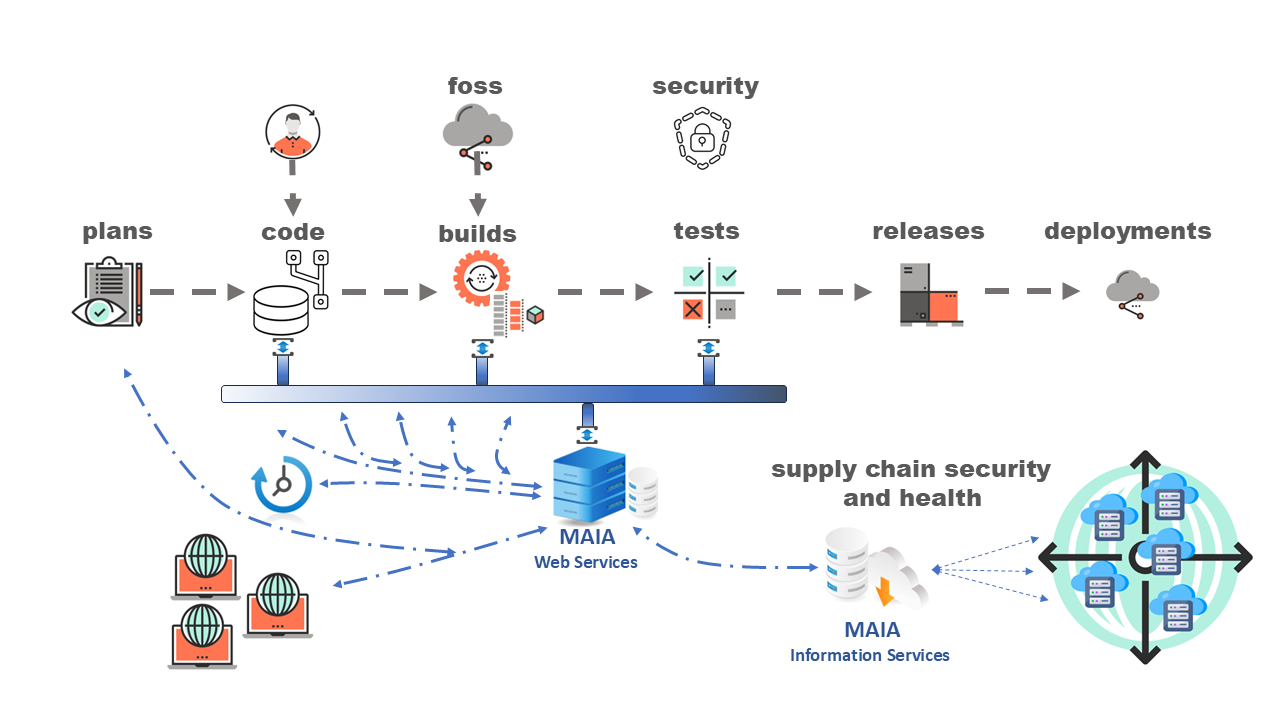
Connect MAIA to your software development pipelines with the following methods to achieve visibility and traceability across the entire system.

  • Bus messages through the Kafka high-capacity streaming platform.
  • RestAPI connections.
  • Websocket communication.
  • HTTPS.

Stream data through the high-speed message bus with Glimse* messages.

Version control

Continuously track changes from multiple version control systems and repositories. Stream changes with bus messages.

Build services

Transfer data from your build tools regarding build activities, included components, license information, current status, and more.

Automated tests

Stream information about test suites, test cases, and results from tests at all levels: acceptance, system, integration, security, and unit tests. Stream current status and end results.

Security and compliance.

MAIA connects to various information sources to provide you with the current security status for your products. It notifies you of published vulnerabilities, exploits, and attacks affecting your software. You can analyze and assess risk and then decide on remediation at the level you choose.

Detect vulnerabilities

MAIA automatically detects vulnerabilities in software components/versions used in current and past builds.

Discover exploitation

MAIA discovers ongoing or potential high risk for exploitation of the your existing vulnerabilities.

Maintain software health

Continuous monitoring of the open-source software you are using, is there an update available, is the project up and running, archived, abandoned, etc.

Analyze and prioritize.

Analyze vulnerabilities using the chosen method and then set remediation priorities.

Automated tests.

Visualizing automated tests boosts test management efficiency, team communication, and product quality by making test results immediately understandable and actionable at scale.

Test results in real-time

Transfer your test data through the streaming platform and get live progress and results.

Create unified reporting

Send standardized test verdicts to get unified visualization and reporting.

Visualize for commitment

Visualize to create commitment and a sense of responsibility, resulting in high quality.

Remediate bugs faster

Get instant failure reports and find out what went wrong using integrated analysis tools.

Insights from history

Get insights by comparing your latest tests with stored data from multiple test runs from the past.

Identify regression errors

Identify regression errors to ensure that previously developed and tested software still performs as expected.

Find recurring failures

Identify 'flaky' test results to find troublesome underlying issues regarding environment, communications, etc.

Performance impact

Measure timing for the same test case over multiple test runs to understand code changes' performance impact.

Know everything about the software you are about to release.

MAIA is creating a comprehensive report for each software build. The report offers both summarized high-level information and a lot of low-level details for all stakeholders.